
Stitch Like a Pro: 7 Common Embroidery Mistakes (and How We Help You Fix Them)
- Janet Emma
- Mar 15
- 5 min read

Custom embroidery is a physical process. It involves needles, thread, and fabric. Unlike digital printing, it has physical limitations. Many designs fail because they do not account for these limitations. Hard Re-Set Inc. has 25 years of experience in custom apparel. We see these mistakes daily. We fix them before they go to production.
NO BULLSH%$ JUST GREAT WORK.
1. Small Text and Fine Detail Issues
The most frequent mistake in embroidery services is undersized text. Standard embroidery thread (40 weight) has a specific thickness. If a letter is smaller than 0.25 inches (6mm) in height, the thread will overlap itself. This creates "thread nests" and "birds' nests" on the underside of the garment. The needle punches too many holes in a small area, which can shred the fabric.
Small text becomes unreadable. The "holes" in letters like 'e', 'a', and 'o' close up. At Hard Re-Set Inc., we audit every design. If your text is too small, we recommend increasing the size or simplifying the font. We prioritize legibility.
The Fix:
Maintain a minimum height of 0.25 inches for all lettering.
Use sans-serif fonts for small text.
Avoid fine scripts or delicate serifs at small scales.
2. Ignoring Fabric Weight vs. Stitch Density
Stitch density is the number of stitches in a given area. Heavy stitch counts on lightweight fabrics cause puckering. If you put a high-density corporate logo on a thin performance tee, the fabric will pull and ripple around the design. It looks unprofessional.
Conversely, low-density designs on heavy fabrics (like sweatshirts) allow the garment's texture to show through the thread. This makes the design look "thin" or "cheap."
Hard Re-Set Inc. matches the digitizing process to the specific garment. We adjust the "push and pull" compensation based on whether you are ordering a heavyweight sweatshirt or a light polo.
The Fix:
Match heavy designs to heavy fabrics.
Use lighter stitch counts for performance wear.
Use proper stabilization/backing (cut-away vs. tear-away).
3. Poor Thread Color Contrast
Contrast is essential for visibility. A dark navy logo on a black shirt will be invisible from three feet away. While "tone-on-tone" is a specific aesthetic choice, it is often an accidental mistake made by customers.
Thread has a sheen. It reflects light differently than fabric. However, if the colors are too similar in value (darkness/lightness), the design disappears. Hard Re-Set Inc. provides digital proofs to ensure your colors pop.
The Fix:
Use light thread on dark garments.
Use dark thread on light garments.
Avoid medium-gray thread on medium-gray fabric.
4. Overly Complex Gradients and Blending
Embroidery thread is solid. It is not ink. You cannot "mix" thread colors on the fly to create a smooth gradient like you can with DTG or screen printing. To create a gradient effect in embroidery, the machine must "dither" or overlap different thread colors.
Complex photographic gradients rarely translate well to thread. They often look cluttered and muddy. We simplify designs to ensure they look clean and sharp.
The Fix:
Use solid color blocks where possible.
Limit gradients to two or three thread colors.
Accept that thread gradients will have a "stepped" or "textured" look.
5. Incorrect Hooping and Tension
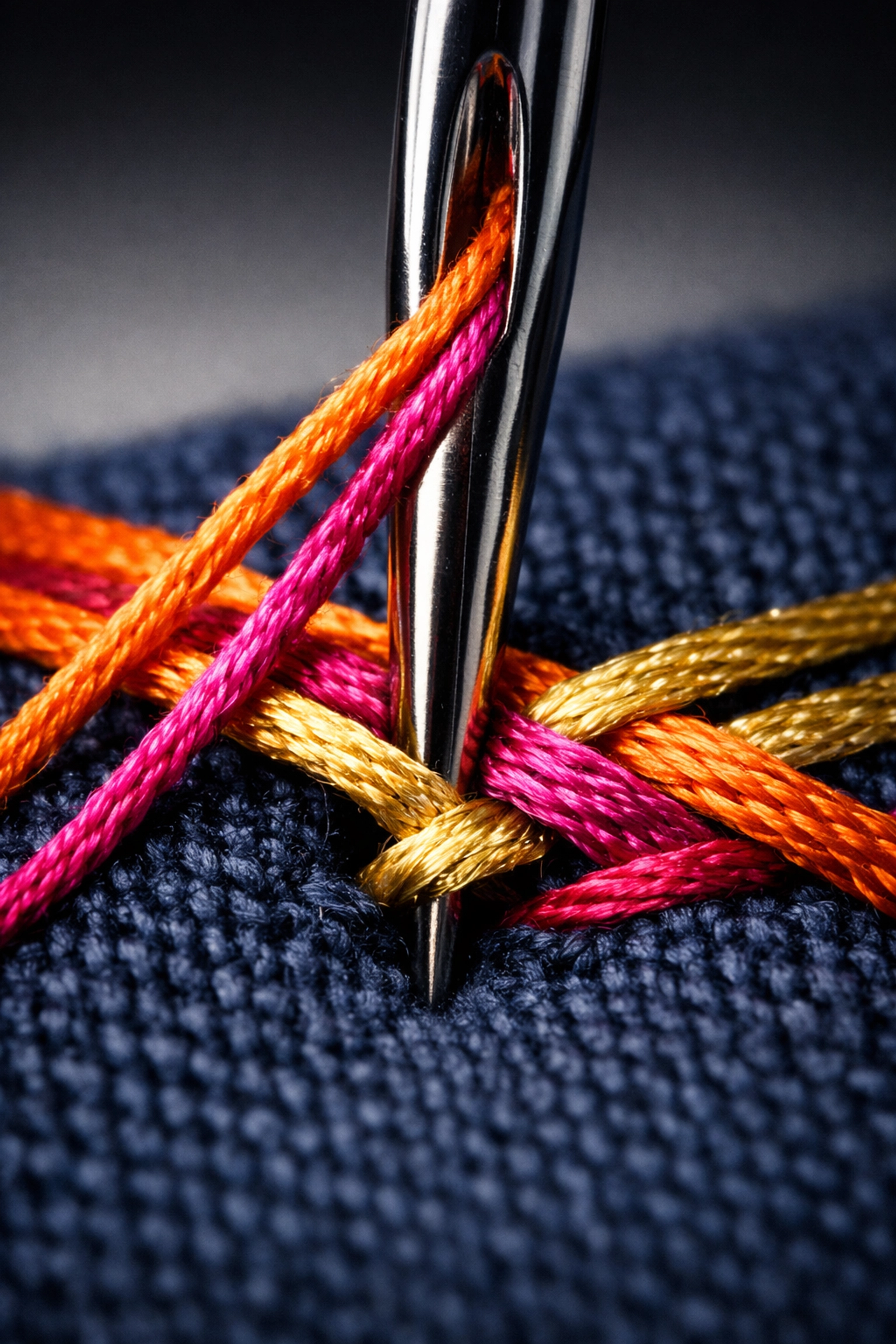
Professional embroidery requires the fabric to be "drum-tight" in the hoop. If the fabric is loose, the needle will drag the fabric as it moves. This causes registration errors. Your borders won't line up with your fills. Your circles will look like ovals.
Beginners often pull the fabric diagonally, which warps the grain. At Hard Re-Set Inc., we use industrial-grade pneumatic and magnetic hooping systems. This ensures consistent tension across every garment in your order. No shifting. No warping.
The Fix:
Use industrial equipment.
Ensure the grain of the fabric is straight before tightening the hoop.
Do not over-stretch thin fabrics.
6. Using the Wrong Type of Needle or Thread
Not all embroidery is the same. Hats require different needles than t-shirts. Heavy denim requires different needles than silk. Using a blunt or oversized needle creates visible holes (perforations) in the fabric that remain even after the thread is removed.
We use specific needles for specific jobs. Sharp points for woven fabrics, ballpoints for knits. We use high-quality polyester threads that are bleach-resistant and won't fade or bleed.
The Fix:
Use professional embroidery services with high-end machinery.
Match needle type to fabric weave.
Replace needles every 8-10 hours of run time.
7. Overlooking Custom Patches as an Alternative
Direct embroidery isn't always the right choice. For designs with extremely high detail, complex borders, or placement on difficult areas (like the seams of a hat), custom patches are superior.
Custom patches are embroidered separately and then applied to the garment. This allows for higher detail and eliminates the puckering issues common with direct embroidery on thin fabrics. We offer high-quality custom patches for brands that want a premium, dimensional look.
The Fix:
Consider custom patches for high-detail logos.
Use patches for outerwear and heavy hats.
Use patches for "unity" or "membership" gear.
The Hard Re-Set Inc. Advantage
We have spent 25 years perfecting the craft of custom apparel. We don't just "hit print" or "start stitch." We analyze your art. If we see a mistake: like text that is too small or colors that won't contrast: we tell you.
We don't send out garbage. Our reputation is built on the fact that we catch errors before they become permanent on your clothes. Whether you need a single hoodie or a thousand hats, we provide the same level of professional scrutiny.
NO BULLSH%$ JUST GREAT WORK.
Fast Turnaround: We get your gear to you quickly.
No Setup Fees: No hidden costs in your quote.
Premium Quality: We use the best threads, the best needles, and the best machines.
Technical Checklist for Your Next Order
Before you submit your design for embroidery services, run through this list:
Is my text at least 0.25" tall?
Is there enough contrast between the thread and the fabric color?
Is the design too heavy for the fabric I chose?
Can I simplify the gradients into solid colors?
Would this look better as a custom patch?
If you aren't sure, ask us. That is why we are here.

Summary of Fixed Mistakes
Mistake | Result | The Hard Re-Set Fix |
Tiny Text | Unreadable clumps | Mandatory minimum sizing checks |
High Density on Thin Fabric | Puckering/Wrinkling | Custom digitizing per garment type |
Low Contrast | Invisible logos | Color consulting and digital proofs |
Complex Gradients | Muddy/Messy look | Design simplification for thread |
Poor Hooping | Misaligned borders | Industrial-grade hooping systems |
Cheap Materials | Fading/Bleeding/Holes | Premium poly-thread and specialized needles |
Forcing Direct Embroidery | Bad results on seams | Expert custom patch alternatives |
Experience matters. 25 years in the business means we have made: and fixed: every mistake in the book. Trust the pros.
Comments